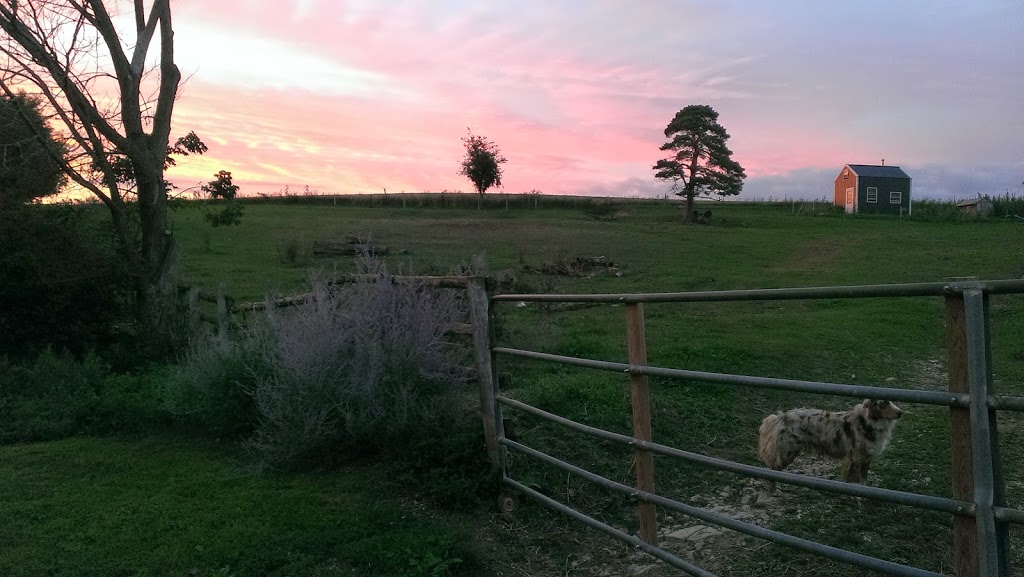
As promised, I will start this new series on how I built my tiny house. Later series will involve different tricks and tips that I have learned while living there.
Sadly I don’t have many photos of the base prep. I was so excited about doing it I didn’t document it like I did the rest of the process.
When I was first researching small house building, I found the resources and information very unhelpful. A few people posted about the actual construction, but it seemed that they were much more experienced carpenters. I decided that something as simple as possible would be my best option. My dad suggested an A-frame but I wasn’t sure how I would make use of all the extra space, and angles really aren’t my thing. I thought about a lean-to type, but decided that may be a little too hard to move since the whole house needed to be on skids and able to be moved around if necessary. As I was in my parents kitchen one day, it dawned on me. Why don’t I just copy the kitchen? I knew I could easily live in a house that size and it even had an upstairs. My parents kitchen was an old cabin that an immigrant Norwegian family lived in for many years. In this small house there lived two adults and quite a few children. This cabin was eventually abandoned and used as a wood shed. It was later cleaned out and attached onto the house it is a part of today. I’m big into heritage and old fashioned stuff, so it seemed like the perfect solution to my problem. I would soon be living in a house that was 12′ x 16′ and had a loft.
Now came the question of where to put it on the farm. I originally wanted it out in the pasture by the spring. That way I could build a little spring house if needed, and would have a fresh supply of water. It was a beautiful spot but this idea was scrapped after I decided it was too close to the main road (I wanted privacy), and getting to my house would be a bit of a struggle in the winter. Plus it was almost a quarter mile from the main farm buildings, and I wanted to be closer to them so that chores wasn’t such an issue.
My dad then suggested a spot where the old corn crib use to be by the machine shed. It was just up the hill from their house, already had a cement foundation that I could build on, and there would always be a good breeze up there. Plus the machine shed was to the North and would block out some of the cold. It could also be used to store the wood I needed in the winter time. Sold.
I called the zoning office and talked to the man about getting a permit. He was very helpful and informative, and approved me right away thanks to satellite technology. In our township you are only allowed two dwellings on a farm. Some townships you are only allowed one. Because my house will eventually be moved to another farm that I will inherit, he was also able to approve my moving it to that farm as well. Killed two birds with one stone. I believe I payed around $40 for a permit because of the size of the house which I call a cabin for obvious reasons.
Now that I was approved and ready to go, my goal was to spend less than $5000. I am not made of money and needed to be as frugal as possible. This demanded A LOT of research. I found a couple houses built online that were well under $5000 but their occupants lived in warm climates. Here in cold, snowy Minnesota, I learned that the extra costs were all for heat retention. This is where my brother came into play. He had just bought a foreclosure that was used as a rental and was fixing the whole thing up. Most of the work he was doing himself. I emailed him and told him what was going on and that I needed help with a materials list and the cost, so that I would know if I could swing it or not. He came through in amazing fashion. He put together a materials list for me with all the prices, which came to under $3000 after we added in the cost of siding.
The siding choice was a big debate. I couldn’t decide what I wanted and what would be feasible. Cedar was my first thought because I knew I couldn’t afford a real log cabin. After much discussion with my father, and realizing that my neighbors would be of the bovine nature, we decided that steel would be the best. That way if the cattle got through the fence and wrecked some siding it would be cheaper and easier to replace than any of the others I was considering.

I wanted to do all of it myself but Fall was quickly flying by, and I had hoped to get it up as soon as possible so that I could work on the inside during the Winter. I have a good friend that is a carpenter who happens to be Amish, which some people might find extraordinary, but when you live in Amish country it’s kind of normal. I told him what I was going to do. He seemed very excited for me. I told him that I had enough money to pay three guys for one day to build the main frame of my house since that was something I was unsure of how to do. He quickly found two other guys to help him since he happily volunteered himself right away.
Before construction could begin we cleaned up the old base of the corn crib and any other debris that was around the area. My dad took the tractor and the skid loader and leveled out the area around the old cement footings. He had to cut away a foot or two of the hillside but for the most part it went really fast as there wasn’t a whole lot to do in that respect.
On the cement footings that the old corn crib stood on, we put three,16′, 8 x 8s for the skids. There were only two footings, so the third had to be put on some old treated 8 x 8s that came from a retaining wall that I ripped out for a friend of mine. My dad and I built the base on the skids using 2 x 6s for the floor joist. My dad has built quite a few outbuildings and lean-tos with just some power tools and a square. His ability to make things level and straight without the help of technology is uncanny. We squared the frame up which took very little effort. I had managed to acquire some one inch insulation foam board from a friend that wanted it gone. I used that as the floor insulation.
I used minimal insulation on the flooring because I knew the house would be warm in the Winter, and wanted the floor to be cold to offset the heat the stove would put out. It would also keep it cool in the Summer. Though my sanity was questioned several times over this decision, it has turned out just as I predicted. I can’t take all the credit for being wise as my parents kitchen has a wood cook stove and no floor insulation. It’s sitting on the logs that it was put on over a hundred years ago when it was put on the house. I had observed the temperature of the kitchen floor for almost thirty years.
We put the sheeting over the foam board and we were done. It went together really slick in less than a day, and was completely level. That was a nice surprise. We covered everything in tarps, and waited for the Amish to arrive and start on the frame.

 trailstothemidwest
Leave a comment